Posts

The Promise of AI: A Journey Beyond Time-Saving.

Image
As the Director of e-Learning at Marlborough Boys' College, I find myself constantly navigating the evolving landscape of educational technology. The latest buzz is Artificial Intelligence (AI) and its potential to save time for teachers with developing new worksheets or lesson plans in the blink of an eye. I have watched on my social feeds as my international colleagues have attended the most recent ISTE conference in Colorado and been introduced to plethora of AI tools that promise to free up and save time.  While this promise is alluring, a closer examination reveals that the history of time-saving technologies tells a different story. Moreover, our understanding of time itself, especially from indigenous and non-capitalist perspectives, challenges the very notion of time as a commodity to be saved or lost. Throughout history, many innovations have promised to save us time. From the invention of the vacuum cleaner to the rise of personal computers, each technological leap was ha...

Student Attendance - A Unique New Zealand Problem?

Image
As teachers, we are acutely aware of the importance of student attendance for academic success and overall well-being. In recent times, the New Zealand government has taken a keen interest in this issue, acknowledging a concerning trend in declining school attendance rates. Prime Minister Christopher Luxon has set forth an ambitious goal to have 80% of students attend school for 90% of the term, highlighting the government’s commitment to reversing this downward trajectory . The government’s Attendance Action Plan emphasizes the significance of attendance and proposes initiatives to address the root causes of absenteeism. But is this absenteeism a local or global phenomenon? and how can it be solved? Global Trends in Student Attendance Globally, the picture of student attendance is complex and multifaceted. While there is a surge in demand for higher education, with projections of an additional one billion post-secondary graduates by 2050 , the scenario at the primary and secondary lev...

Promptly Educated: Crafting the Future of Learning with Effective Prompts

Image
As a teacher passionate about integrating AI into education, I’m excited to share the PREPARE model , developed by Dan Fitzpatrick. This model is a fantastic tool for crafting prompts that yield creative and effective assessment and learning tasks. Let’s dive into each component of the PREPARE model and explore how to apply it to a senior physics creative learning task. Prompt: Setting the Stage Begin with a clear, concise command. For a senior physics task, you might say, “Create a lesson plan that explores the concept of quantum mechanics through interactive simulations.” Role: Defining the AI’s Identity Assign a role to the AI to provide context. For instance, “You are a virtual teaching assistant experienced in physics education and student engagement.” Explicit: Clear Instructions Be specific about your expectations. “Include objectives, activities, and assessment methods that align with the Next Generation Science Standards.” Parameters: Establishing Boundaries Set the scope ...

The Secrets of SHM: The Importance of Understanding and Physics Formulae.

Image
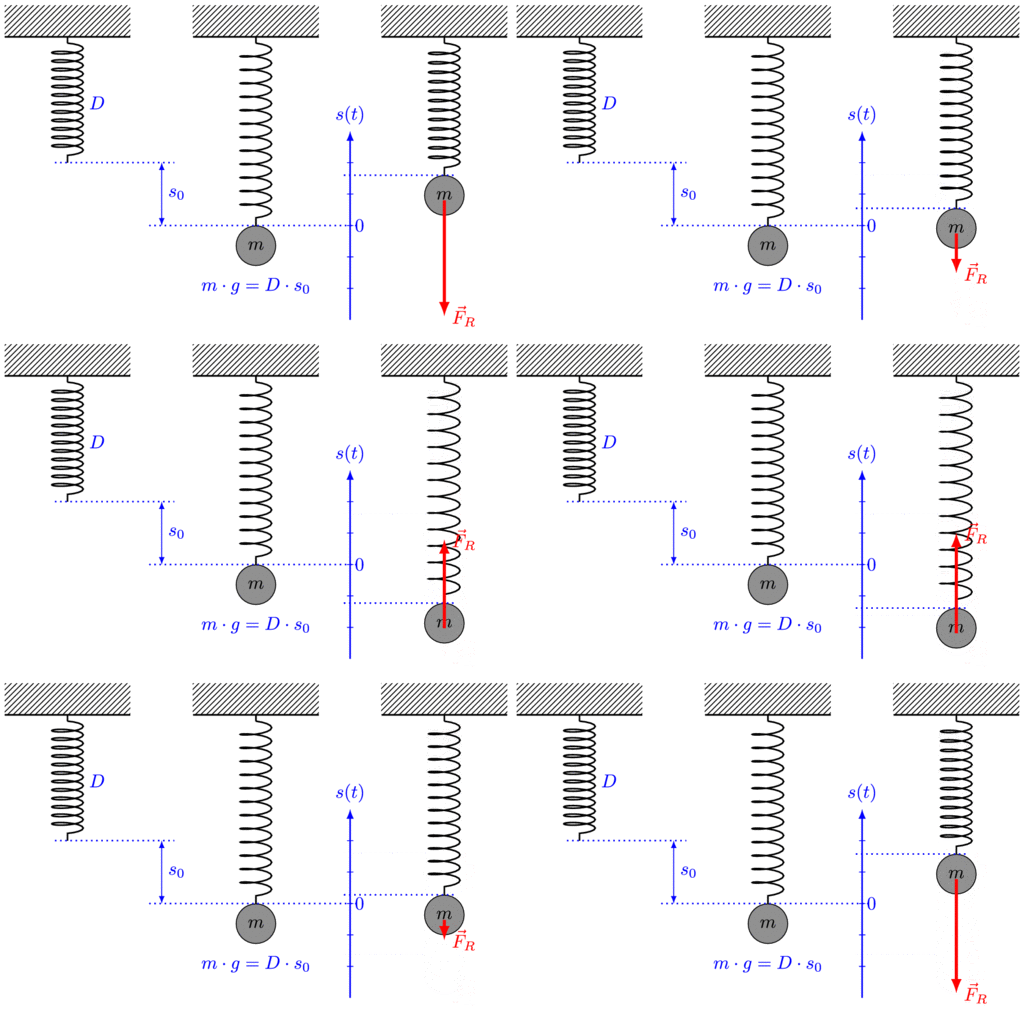
Physics is a fascinating subject that reveals the secrets of nature and the principles of motion. To describe the physical phenomena and the relationships between different quantities, physics uses a lot of formulae. However, learning physics is not just about memorizing these formulae and plugging in numbers. It is also about internalizing these formulae, which means understanding their origin, derivation, and interpretation. Internalizing formulae can help you to apply them more effectively, solve problems more creatively, and appreciate the beauty of physics more deeply. In this blog post, I will show you how to internalize physics formulae better, using the example of simple harmonic motion. What is simple harmonic motion? Simple harmonic motion (SHM) is a type of motion that happens when something moves back and forth around a fixed point, and the force that makes it move is always pointing towards that point, so the displacement from that point is always in the opposite direction...